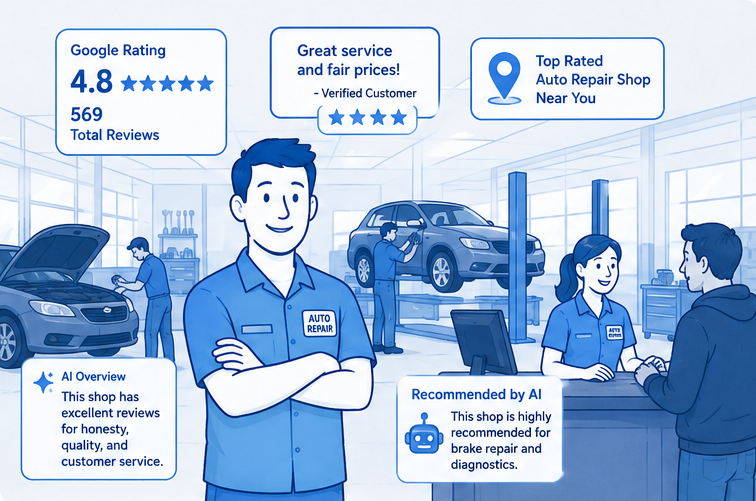
Google Local Services Ads (LSAs) can be one of the most cost-effective ways to fill your bays with high-quality repair jobs. But when they don't work right, you're paying for leads that never convert. AutoBoost | Business Actualization helps auto repair shops optimize their LSA campaigns to attract the right customers and track real revenue, not just poor-quality leads.
 This guide walks you through everything you need to know about troubleshooting and optimizing your LSAs. From disputing bad leads to selecting the right job types, setting the right budget, and improving lead quality. We cover the full playbook so you can get more booked appointments and fewer wasted ad dollars.
You'll learn how to identify common LSA problems, fix them step by step, and connect your ad performance to actual shop revenue. Let's get your Local Services Ads working the way they should.
Key Takeaways: Fix Your Auto Repair Shop's Google Local Services Ads
- LSAs charge you per lead, not per click, so every bad lead you can't dispute directly impacts your ROI and budget.
- Selecting precise job types and service areas prevents you from paying for leads outside your specialty or geographic coverage.
- AutoBoost | Business Actualization connects your LSA leads to actual invoices, showing you which campaigns drive real revenue versus wasted spend.
- Response time matters; contacting leads within five minutes increases your booking rate significantly compared to slower follow-up.
What Are Google Local Services Ads and How Do They Work?
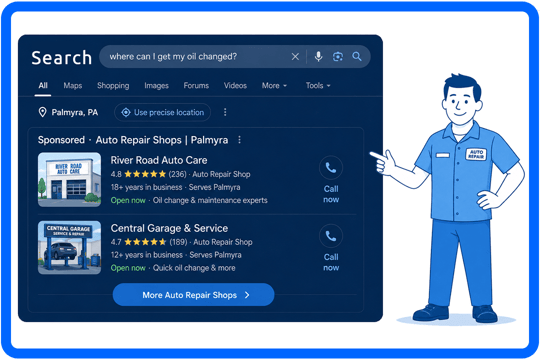
Google Local Services Ads appear at the very top of search results when someone looks for services like "auto repair near me" or "brake repair in [your city]." These ads display your shop's name, Google review rating, and phone number.
Unlike traditional Google Ads where you pay each time someone clicks, LSAs use a pay-per-lead model. You only get charged when a potential customer calls, sends a message, or submits a booking request. This makes LSAs attractive for auto repair shops because you're paying for actual contact attempts rather than casual website visitors.
To run LSAs, your shop must pass Google's verification process, which includes background checks, license verification, and proof of insurance.
Why LSAs Fail for Many Auto Repair Shops
LSAs sound straightforward, but many shop owners find themselves frustrated with poor lead quality, unexpected charges, and campaigns that don't generate booked appointments. The most common issues stem from incorrect profile setup, poor response times, and mismatched job types.
When your LSA profile lists services you don't actually offer, or covers geographic areas you don't serve, you'll receive leads from people looking for something else entirely. Google will still charge you for these leads. Before 2024, you could dispute these charges manually, but that option no longer exists.
Another major problem is slow response time. If you take hours or days to return LSA calls, those leads have already called your competitors. Research shows that responding within five minutes dramatically increases your chance of booking the job compared to waiting even thirty minutes.
How the LSA Dispute System Changed in 2024
Google eliminated the manual dispute button from the LSA dashboard in mid-2024. Previously, you could flag a lead as spam, out of service area, or requesting a service you don't offer, and Google would review and credit your account within 48 hours. That system is completely gone.
The replacement is an automated credit system powered by Google's machine learning. Google's AI reviews every charged lead and automatically issues credits for leads it determines are invalid. You cannot request a credit—Google's algorithm decides.
Here's the critical change: Google no longer credits leads for "job type not serviced" or "geo not serviced." If your profile includes job types you don't actually perform, or service areas beyond your real coverage, you'll pay for those mismatched leads with no way to get money back. This makes accurate profile setup more important than ever before.
What You Can Still Do to Influence Lead Quality
While manual disputes are gone, you can still influence the system through the "Rate this lead" feedback tool in your LSA dashboard. When you mark a lead as "Very dissatisfied" and select a specific reason, this feedback can trigger a credit, though it's not guaranteed.
Credits typically appear within 30 days of the lead date. The original charge will still show on your invoice even after a credit is applied. This is normal and doesn't mean the credit failed.
How to Set Up Job Types Correctly for Your Auto Repair Shop
Job type selection is one of the most critical decisions in your LSA setup. The job types you select determine which searches can trigger your ads. If you select too many job types, you'll receive leads for services you don't offer. If you select too few, you'll miss potential customers.
Start by listing every service your shop actually performs and is staffed to handle. For a general repair shop, this might include oil changes, brake service, engine diagnostics, tire services, and basic maintenance. For a specialty shop, focus on your core expertise like European vehicles, diesel repair, transmission work, or hybrid systems.
Avoid selecting job types just because they seem popular or because you could technically do the work. If you rarely accept transmission rebuilds or don't have the equipment for diesel exhaust repairs, don't include those services. Every mismatched lead costs you money with no recourse under the new dispute rules.
Reviewing and Adjusting Your Job Types
Check your job types quarterly by reviewing the leads you're receiving. If you notice a pattern of calls for services outside your sweet spot, remove those job types from your profile. It's better to receive fewer, more relevant leads than to pay for calls that never convert.
Document which job types produce your highest-value work. If brake services consistently lead to additional discoveries and larger repair orders, make sure those job types are prominently featured. If oil changes mostly attract price shoppers who never return, consider whether those leads are worth including.
How to Define Your Service Area Without Wasting Budget
Your service area setting determines which geographic locations can trigger your LSA. Setting your service area too broadly means paying for leads from drivers who would never realistically visit your shop. Setting it too narrowly means missing potential customers within reasonable driving distance.
For most urban and suburban auto repair shops, a service radius of 10-15 miles captures your realistic customer base. Drivers generally choose repair shops close to their home or workplace because of convenience for drop-off and pick-up. Going beyond 20 miles rarely makes sense unless you're a specialty shop with few local competitors.
You can exclude specific zip codes or towns within your radius if you know those areas don't convert well. This is helpful if a neighboring town is served by a major dealership network or if distance and traffic make certain areas impractical despite being geographically close.
One Profile Per Major Market
Each LSA profile works most effectively when focused on one major market. If you have multiple locations, create separate LSA profiles for each rather than trying to cover multiple cities with a single profile. This improves your relevance for local searches and prevents budget competition between locations.
Think of each LSA profile as a focused campaign. Just like you wouldn't run one marketing campaign targeting three different cities simultaneously, don't ask your LSA profile to do the same.
How to Set Your LSA Budget for Maximum ROI
LSA budgeting works differently from traditional advertising. You set an average weekly budget based on how many leads you want, and Google manages delivery accordingly. You can exceed your weekly budget in any given week, but you'll never exceed your monthly maximum (calculated as weekly budget multiplied by average weeks per month).
Start by determining how many new customers you need monthly to hit your revenue goals. If your average repair order is around $400 and you want to add $8,000 in monthly revenue from LSA leads, you need roughly 20 new booked jobs. If your lead-to-booking conversion rate is 40%, you'll need about 50 leads per month.
Auto repair LSA leads typically range from $10-$30 per lead depending on your market and competition. For 50 leads at $20 average, budget around $1,000 monthly or $250 weekly. Start conservatively and increase your budget once you've established baseline conversion rates.
Tracking Budget Performance
Your LSA dashboard shows how much you've spent and how many leads you've received, but those numbers don't tell you what matters: how many leads became paying customers. This is where tracking becomes essential.
Business Actualization's Revenue Attribution platform connects your LSA leads to actual invoices, showing you which marketing channels, including LSAs, generate real revenue versus just contact volume. When you know that LSA leads convert at a specific dollar amount, you can calculate true cost-per-acquisition and adjust budgets accordingly.
How to Improve Your LSA Lead Quality
 Lead quality issues plague many auto repair shop LSA campaigns. Common complaints include calls from price shoppers who never book, inquiries for services you don't offer, and leads from outside your service area. While you can't control who searches for auto repair, you can influence who clicks and calls.
Your Google Business Profile directly impacts your LSA performance. Make sure your profile includes accurate business hours, all services you actually offer, high-quality photos of your shop and team, and recent customer reviews. LSAs pull information from your GBP, so inconsistencies between the two create confusion.
Reviews matter significantly for LSA rankings and click-through rates. Shops with 50+ reviews and ratings above 4.5 stars appear more prominently and earn more trust from potential customers. If your review count is low, implement a consistent review request process after every completed repair.
Response Time Makes or Breaks Your LSA Results
How quickly you respond to LSA leads dramatically affects your conversion rate. Studies consistently show that contacting a lead within five minutes increases your booking rate by 9x compared to waiting even thirty minutes. After an hour, your chances of reaching a live prospect drop significantly.
Set up systems to respond immediately when LSA leads come in. This might mean assigning front desk staff to prioritize LSA calls, using a dedicated phone line with immediate answering, or implementing callback systems for missed calls. If you can't answer, at minimum send an immediate text acknowledging the inquiry and committing to a specific callback time.
How to Use LSA Bidding Modes Effectively
Google offers three bidding modes for LSAs, each with different levels of control and automation. Understanding these options helps you optimize spend based on your business goals and comfort with Google's algorithms.
Maximize Leads uses Google's automated bidding to get you the most leads possible within your budget. This is Google's recommended setting and works well for shops that want hands-off management. The algorithm adjusts bids based on competition and likelihood of conversion, which means costs fluctuate.
Target Cost Per Lead (tCPL) lets you set an average price you're willing to pay per lead. Google's system then optimizes to hit that target over time. This gives you more cost predictability while still benefiting from automated optimization.
When to Use Manual Bidding
Max Per Lead manual bidding lets you set a hard cap on what you'll pay for any single lead. This gives you the most control but requires more active management. Manual bidding makes sense if you have strong data about your true cost-per-acquisition and want to ensure leads never exceed a specific threshold.
Whichever mode you choose, give it at least two weeks before evaluating results. Google's models need time to learn about your business and local market. Changing bidding modes too frequently prevents the system from optimizing effectively.
How to Track LSA Performance and Calculate ROI
The LSA dashboard shows lead count, cost per lead, and total spend, but these metrics alone don't tell you whether your campaigns are profitable. True ROI measurement requires connecting leads to actual booked jobs and completed invoices.
Start by tracking every LSA lead from initial contact through job completion. Create a simple spreadsheet or use your shop management system to log: lead source, services requested, whether the lead booked an appointment, and if so, the final invoice amount. After a month, you can calculate average revenue per LSA lead.
We builds this tracking automatically for shops using our Revenue Attribution system. Instead of manually logging leads, the platform connects phone calls and form submissions to your shop management software, showing attributed revenue by marketing channel. You see exactly which LSA leads became paying customers and how much revenue they generated.
Calculating Your True Cost Per Acquisition
Cost per lead is not the same as cost per acquisition. If you spend $500 on LSAs and receive 25 leads at $20 each, that looks efficient. But if only 8 of those leads actually book appointments, your true cost per new customer is $62.50. Factor in your average repair order value to determine whether that acquisition cost works for your business.
For example: if your average repair order is $350 and you acquire new customers for $62.50 through LSAs, you're paying about 18% of first-job revenue for acquisition. That's generally acceptable, especially if those customers return for future service. If acquisition cost creeps toward 30-40% of first revenue, investigate lead quality issues or consider adjusting targeting.
Common LSA Problems and How to Fix Them
When your LSAs underperform, systematic troubleshooting helps identify the root cause. Here are the most common problems auto repair shop owners face and specific fixes for each.
Problem: Getting Leads for Services You Don't Offer
This usually indicates your job types are too broad. Review your LSA profile and remove any job categories outside your core services. Remember that Google no longer credits leads for "job type not serviced," so every irrelevant lead is a direct cost with no recovery option.
Also, check that your Google Business Profile categories match your LSA job types. Inconsistencies confuse Google's targeting and can result in mismatched leads.
Problem: Leads from Outside Your Service Area
Tighten your geographic targeting by reducing your service radius or excluding specific zip codes. Check whether your GBP service area matches your LSA settings. Google pulls from both, and conflicts create problems.
If you serve a major metro area, consider excluding distant suburbs where drive time makes your shop impractical. Better to receive fewer, closer leads than to pay for inquiries that never convert.
Problem: Leads Not Converting to Booked Appointments
Low conversion rates often stem from slow response times or poor phone handling. Review your call recordings (available in the LSA dashboard) to identify patterns. Are callers getting voicemail? Is the person answering providing helpful information?
Train your front desk to handle LSA calls as high-intent opportunities. These callers are actively looking for repair services. They've already searched, seen options, and chosen to contact you. A warm, helpful response makes the difference between a booked job and a lost lead.
Problem: High Cost Per Lead
Elevated cost-per-lead(CPL) typically indicates strong competition in your market. Next, review your targeting. High-competition services like "oil change" often carry premium lead costs because many shops target them.
How to Integrate LSAs with Your Overall Marketing Strategy
LSAs work most effectively as part of a broader marketing mix rather than a standalone channel. Shops that rely entirely on LSAs for new customers face risk when Google changes policies, adjusts algorithms, or increases lead costs.
The most resilient marketing strategies combine LSAs for immediate high-intent leads, Google Ads for broader keyword targeting and retargeting, SEO for long-term organic visibility, and reputation management for ongoing review generation. Each channel reinforces the others and protects against single-point failures.
We design integrated marketing systems that align these channels with your shop's operational capacity. When your bays are full, we can throttle lead flow. When you're hiring and expanding, we scale up acquisition. This prevents the common problem of marketing that's either too aggressive for your team to handle or too passive to support growth.
Balancing LSA Budget with Other Channels
A common allocation for growing auto repair shops dedicates a majority of digital ad budget to LSAs and traditional Google Ads combined, with remaining budget split between programmatic display, social media advertising, and email marketing. The exact mix depends on your market, competition, and growth goals.
Track performance across all channels using consistent attribution. When you can see that LSA leads generate $X revenue per dollar spent while social media generates $Y, you can allocate budget rationally rather than guessing.
How to Review and Optimize Your LSA Results Monthly
Consistent monthly review keeps your LSA campaigns performing at their potential. Set aside time each month to analyze key metrics and make data-driven adjustments.
Start with lead volume and cost. How many leads did you receive? What was your average cost per lead? Compare these numbers to previous months to spot trends. If CPL is rising, investigate competition changes or consider narrowing targeting.
Next, review lead quality. What percentage of leads booked appointments? What was the average ticket value from LSA customers? If conversion rate is dropping, examine response times and phone handling. If ticket values are low, consider whether you're attracting the right customer profile.
Finally, calculate actual ROI by connecting LSA spend to attributed revenue. This single number tells you whether campaigns are profitable and by how much. If ROI is strong, consider budget increases. If marginal, troubleshoot lead quality before spending more.
In Conclusion: Getting Your LSAs to Drive Real Revenue
Google Local Services Ads can be a powerful lead source for auto repair shops when set up and managed correctly. The pay-per-lead model means every dollar should connect to a real potential customer, but achieving that requires precise job type selection, accurate geographic targeting, fast response times, and ongoing performance tracking.
The 2024 changes to Google's dispute system make profile accuracy more critical than ever. You can no longer get credits for leads that don't match your services or location, so investing time in correct setup prevents ongoing wasted spend.
Most importantly, connect your LSA performance to actual revenue, not just lead counts. Knowing exactly how much revenue each marketing channel generates lets you make smart budget decisions and proves whether your advertising is truly profitable. We help auto repair shops build these measurement systems and optimize campaigns for real results.
FAQs about Fix Google Local Services Ads for Auto Repair Shops
How much should an auto repair shop spend on Google Local Services Ads?
Most auto repair shops find success starting with budgets between $500-$1,000 monthly. This typically generates 25-50 leads at average costs of $15-25 per lead for auto repair services.
Your ideal budget depends on how many new customers you need and your local competition level. Start conservatively and increase once you've tracked conversion rates.
Can I dispute bad LSA leads?
No, Google removed manual lead disputes in mid-2024. The system now uses automated AI to review leads and issue credits. You can provide feedback through "Rate this lead," but you cannot directly request refunds.
This feedback appears to influence the automated system. Credits can still happen for obvious spam/invalid leads. Leaving detailed feedback also guides future targeting.We recommend focusing on accurate profile setup rather than relying on disputes, since prevention is now the only reliable approach.
What job types should auto repair shops select for LSAs?
Select only services your shop actively performs and is staffed to handle. Common job types include oil changes, brake service, engine diagnostics, tire services, and scheduled maintenance.
Avoid selecting job types you rarely accept. Every mismatched lead costs money with no refund option under current rules.
Why are my LSA leads not converting to appointments?
Low conversion usually indicates slow response times or poor phone handling. LSA callers are high-intent; they've searched, compared options, and chosen to contact you. Responding within five minutes dramatically increases booking rates.
How do I know if my LSA campaigns are profitable?
Calculate ROI by connecting LSA spend to actual booked revenue, not just lead counts. If you spend $500 and generate $3,000 in attributed repairs, you have a 6:1 return.
The AutoBoost | Business Actualization's Revenue Attribution platform automates this calculation by connecting leads to invoices, showing true profitability for each marketing channel.
What's the difference between LSAs and regular Google Ads for auto repair?
LSAs charge per lead (someone contacts you), while Google Ads charge per click (someone visits your site). LSAs appear above regular ads. Many shops run both. LSAs for immediate local leads and Google Ads for broader keyword targeting and remarketing.
Ready to turbo-charge your marketing with managed Google Local Service Ads? Reach out to our team to get started.
About the Author