Most shop owners know reviews matter. What many do not realize is that a single Google review may be worth hundreds or even thousands of dollars to an auto repair shop over time. That sounds exaggerated until you break down how customers actually choose a repair shop today.
Google reviews influence:
- Local search rankings
- Click-through rates
- AI and LLM visibility in search and recommendation engines
- Generative Engine Optimization (GEO) performance
- AI-generated business recommendations and summaries
- Phone call conversion rates
- Consumer trust
- Long-term customer acquisition costs
For auto repair specifically, reviews are even more valuable because customers tend to become repeat clients for years.
The Difference Between Retail and Auto Repair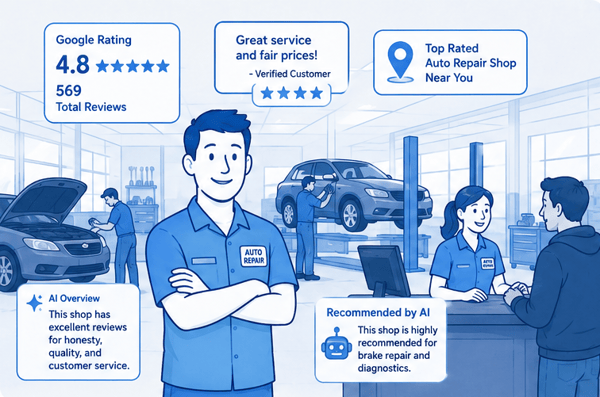
In traditional retail, customers often browse casually. Auto repair works differently.
Most people searching for:
- “Brake repair near me”
- “Check engine light repair”
- “Oil change near me”
- “Mechanic open now”
are not browsing for entertainment. They need help now. That means almost every Google search impression is attached to purchase intent.
The question is not: “Do they need service?”
The question is: “Which shop do they trust enough to call?”
Google reviews heavily influence that decision. Now, increasingly, AI systems are influencing it too.
Reviews No Longer Only Influence Google Rankings
For years, reviews primarily affected:
- Google Maps rankings
- Local SEO visibility
- Consumer trust
That is still true. But the search landscape is changing rapidly.
Consumers are increasingly using:
- ChatGPT
- Google AI Overviews
- Gemini
- Perplexity
- Siri
- voice assistants
- AI-powered search experiences
to ask questions like:
- “Who is the best mechanic near me?”
- “What auto repair shop has the best reviews?”
- “Where should I take my Toyota for brakes?”
- “Most trusted auto repair shop near Hershey”
These systems do not think like traditional search engines. They summarize. They recommend. They compare. And reviews heavily influence the information AI systems surface.
AI Systems Need Trust Signals
Large Language Models (LLMs) and AI recommendation systems rely on publicly available trust signals to determine:
- Credibility
- Authority
- Consistency
- Popularity
Google reviews provide exactly that.
A repair shop with:
- 700 reviews
- 4.8-star rating
- Recent review activity
- Detailed review responses
Creates a much stronger confidence signal than a shop with:
- 42 reviews
- Inconsistent activity
- Mixed ratings
This matters because AI systems are increasingly generating:
- Business summaries
- “best of” recommendations
- Local service suggestions
- Conversational search answers
In many cases, the businesses with the strongest reputation profiles become the businesses AI mentions first.
Reviews and Generative Engine Optimization (GEO)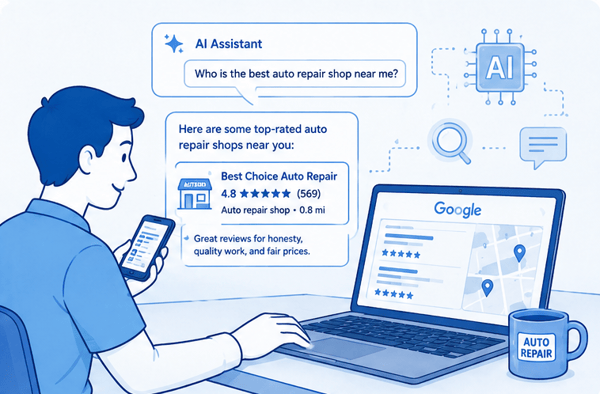
SEO traditionally focused on ranking webpages. Generative Engine Optimization (GEO) focuses on influencing AI-generated answers.
That means businesses now need to optimize not only for search engines, but also for AI recommendation systems. Reviews are becoming one of the strongest GEO signals available to local service businesses.
Because reviews contain:
- Real customer language
- Service keywords
- Trust indicators
- Sentiment
- Proof of customer satisfaction
When customers consistently mention:
- brake repair
- diagnostics
- honesty
- professionalism
- quick turnaround
- specific vehicle brands
Those terms help AI systems better understand what the shop is known for. In many ways, reviews have become decentralized AI training data for local businesses.
Reviews Influence Rankings and Conversion Rates
Google reviews impact local performance for auto repair shops in multiple ways simultaneously.
1. Visibility in Google Maps
Google uses review signals as part of local ranking algorithms, including:
- Review quantity
- Review velocity
- Review recency
- Average rating
- Keyword relevance inside reviews
A shop with:
- 500 reviews
- a 4.8-star rating
- consistent recent activity
Typically has a substantial competitive advantage over a shop with:
- 47 reviews
- a 4.2-star rating
- inconsistent review activity
Especially in the map pack search result rankings.
2. Consumer Conversion
Even when two shops rank similarly, consumers compare trust signals immediately.
A consumer deciding between:
- 89 reviews at 4.3 stars
vs. - 650 reviews at 4.8 stars
Often makes a decision in seconds.
The higher-reviewed shop usually gets:
- More calls
- More form submissions
- More direction requests
- Higher website conversion rates
3. AI Recommendation Likelihood
AI systems tend to favor auto shop businesses with:
- Stronger review profiles
- Higher consistency
- Broader customer validation
- Clearer reputation signals
As AI-assisted local search grows, shops with weak or stagnant review profiles risk becoming less visible, even if they historically ranked well in traditional search.
Estimating the Value of a Review
There is no universal industry number for what one Google review is worth. But we can estimate it using customer lifetime value.
Example Auto Repair Shop
Let’s assume:
- Average repair order: $475
- Average annual customer spend: $1,200
- Average customer retention: 5 years
That customer may represent approximately $6,000 in lifetime revenue. Now, assume improved reviews generate one additional long-term customer for every 10 new reviews
That would place the estimated revenue value at: $6,000 ÷ 10 = $600
In that scenario, one Google review may be worth roughly $600. In many shops, the number may be even higher.
Reviews Compound Over Time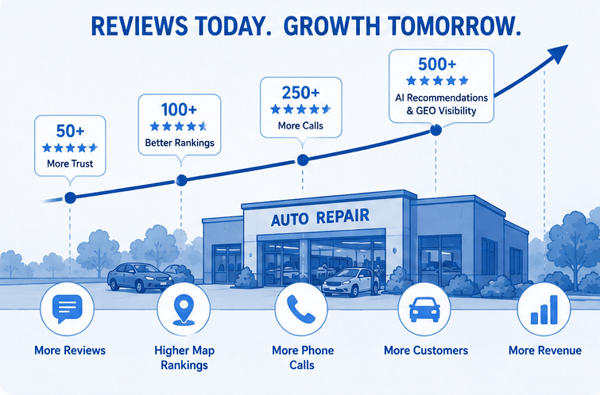
The most important concept is that reviews are cumulative assets. A billboard stops working when you stop paying for it.
Google reviews continue producing value:
- Months later
- Years later
- After marketing campaigns end
Strong review profiles create momentum:
- Better rankings
- More visibility
- Greater AI recommendation frequency
- More trust
- More conversions
- More customers
- More future reviews
That compounding effect is difficult to replicate with traditional advertising alone.
Review Thresholds Matter
Not all review growth creates equal impact.
Certain thresholds tend to change consumer behavior significantly:
- 50+ reviews
- 100+ reviews
- 250+ reviews
- 500+ reviews
The same applies to star ratings:
- 4.0 vs 4.5 is substantial
- 4.5 vs 4.8 is often massive in automotive repair
Consumers understand that no shop is perfect. But they also understand patterns.
A shop with:
- Hundreds of reviews
- Recent activity
- Consistently high ratings
Feels established, trusted, and lower-risk. To both consumers and AI systems.
What We See Across Auto Repair Shops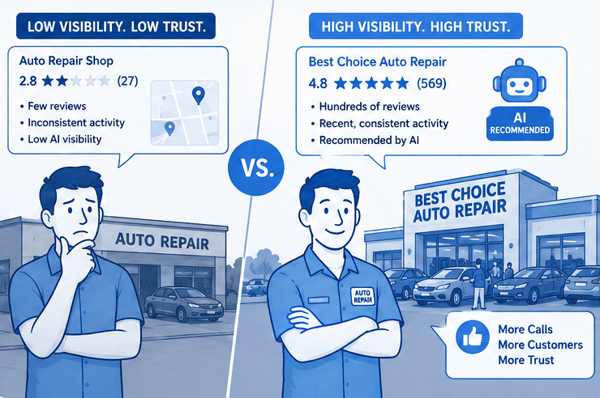
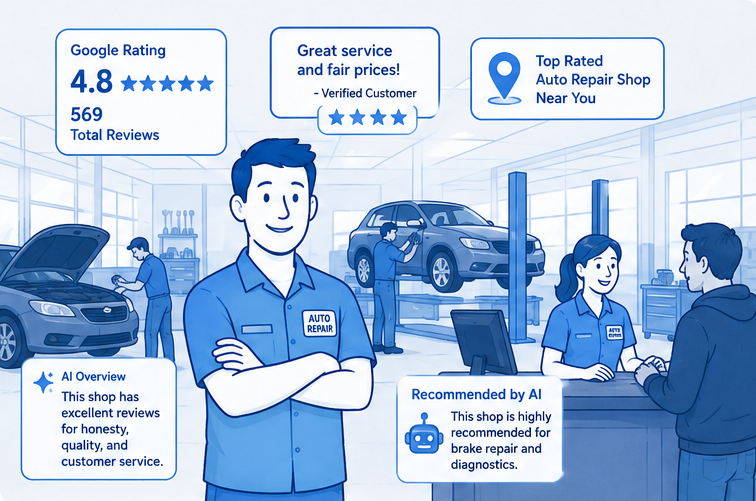
Across clients using our review platform, we consistently see strong review acquisition correlate with stronger local visibility and customer engagement.
Current averages across participating clients:
- 4.8★ average Google rating
- 569 average reviews per client
- 24.4 average new reviews per month
Those numbers matter because consistency matters.
A shop generating:
- 2 reviews per month
and a shop generating - 25 reviews per month
Will likely look dramatically different in:
- Google Maps,
- local SEO,
- I-generated recommendations
Over a 2–3 year period.
The Real Cost of Ignoring Reviews
Most shops do not have a review problem. They have a process problem.
They rely on:
- Inconsistent asking
- Manual follow-up
- Advisor memory
- Random customer participation
Meanwhile, competitors systematically generate reviews every day. Over time, the gap widens. And once competitors establish major review advantages, catching up becomes increasingly difficult. Especially as AI-driven search continues accelerating.
Final Thought
A Google review is not just a testimonial.
For an auto repair shop, it is:
- A trust signal
- A ranking factor
- A GEO asset
- An AI recommendation signal
- A conversion tool
- A long-term revenue asset
The shops that consistently generate reviews are not simply protecting reputation. They are building long-term visibility across both traditional search engines and AI-driven discovery platforms.
About the Author